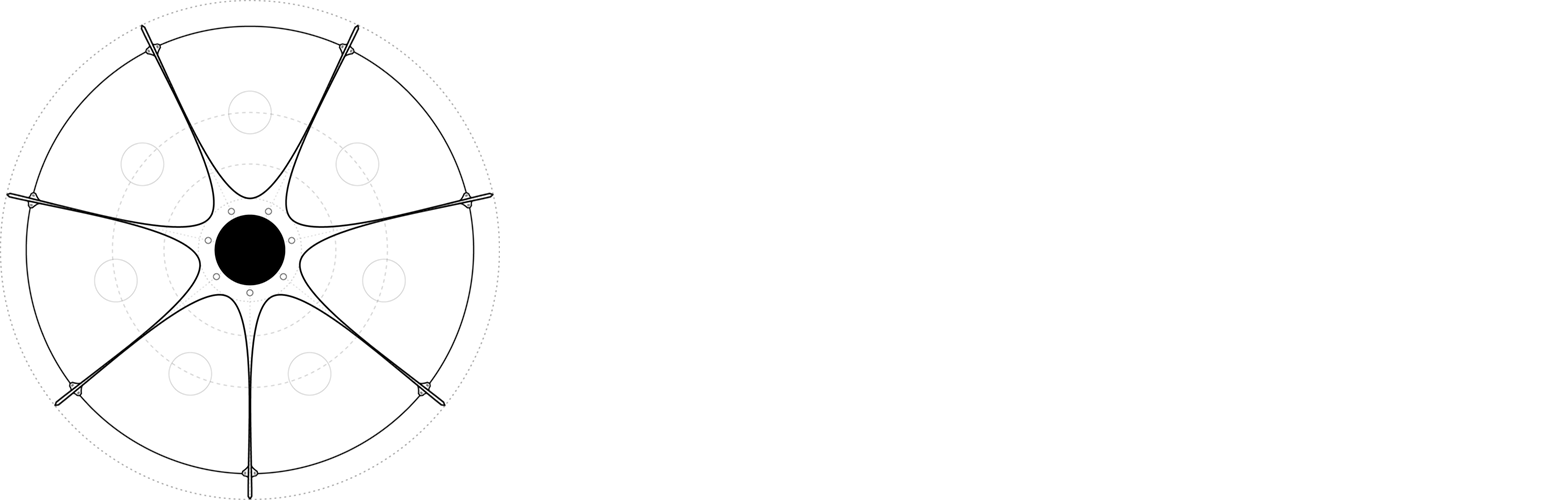
Long ago, the vast starship Q’Enmari was nearly destroyed in a disastrous incident. As a result of that event and the damage it caused, Q’Enmari was completely redesigned with both redundant safety systems and passenger comfort in mind.
In her current configuration, Q’Enmari’s passengers experience a safe and comfortable journey without awkward periods of microgravity or “zero-G.” The safety and system redundancies will be addressed in a future post. Here, we’ll focus on how her passenger comfort is accomplished through her unique radial design and carefully planned habitation spaces.
Each of Q’Enmari’s seven radial segments contains its own habitation module: a spherical habitat with an internal volume of roughly one cubic kilometer. The upper regions of each sphere are designed to feel open and airy, with broad interior spaces, terraced levels, and room for light, air, movement, and community.
The lower regions of each habitat are deliberately heavier, containing storage, manufacturing and recycling, and multiple redundant power systems. This bottom-heavy design allows each sphere, within its cradle, to orient itself naturally toward the current direction of “down,” whether that gravity comes from thrust, deceleration, or spin.
Here’s how it works, using just physics and no magical “artificial gravity”:
The ship moves through space “face on.” It is not designed with a permanent “up” or “down” in its structure. It is a vast disc with a central core opening, and when it travels it moves like a bead would slide along a necklace, not like a thrown frisbee. The ship’s engines are integrated and designed in such a way that she can thrust forward or backward without having to do any actual “turn over.” That is, both of her disc’s faces have thrusters. Neither face is considered “front” or “back,” and she travels with equal ease in either direction.
Despite the ship accelerating and decelerating at approximately one gravity, her passengers feel no abrupt change in the gravity they experience due to the ship’s unique design. Without careful planning and engineering, the change from acceleration to deceleration could suddenly shift the passengers’ perceived gravity, with a period of uncomfortable zero-G between phases. Therefore, to create a seamless transition between orientations, the ship slowly changes thrust and spin; the changing combination of these forces gives passengers a near-constant 1G.
When accelerating or decelerating, the habitation spheres rotate to orient themselves so that “down” aligns with the passengers’ felt gravity. During the long months and years of acceleration, down is “behind” the ship; likewise, during periods of deceleration, down is “ahead of” the ship, in the direction of travel.
Between speeding up and slowing down — and with gratitude to the Lupole Drive taking advantage of the Medium for speed and safety — the ship can coast almost indefinitely, at incredible speeds, in the nearly empty, frictionless expanses of deep space.
During this part of a trip — while coasting — the “down” direction for the habitats becomes fully “outward,” with the ship spinning slowly around her central axis. This gives the habitats matching felt gravity via centrifugal action.
As the ship approaches her top coasting speed, she gradually reduces thrust at the same time as she slowly starts to spin. Slowly, almost imperceptibly, the pull on the heavier bottom section of each habitat starts to shift from axial to outward, degree by degree. By the time the ship has completely cut off thrust, it is spinning about one rotation every two minutes, and the module inhabitants are now feeling gravity that is fully centrifugal.
When the ship is ready to start decelerating, she starts to apply thrust from the opposite face and gradually slows her rotation. The bottom-heavy habitats slowly orient so that “down” shifts toward the direction of the ship’s travel.
Finally, as she approaches her destination and deceleration tapers off, she goes back to rotating so that, at rest, she is providing her passengers with comfortable spin gravity again.
OTHER NOTES TO CONSOLIDATE:
Maybe she herself no longer really knows where her ORIGINAL name, exactly, comes from. She was, originally, a luxury ship meant to carry passengers between specific, relatively close planets. At some point, her range expanded; she may have been owned; she may have been refit or refurbished multiple times. Originally she may not have been conscious, but only highly automated and high-operating artificial intelligence. Eventually she developed her own sapience and identity. She continued moving passengers even after the process became too spread out and too decentralized to still be operating for the original "company" that created and/or refit her. She operated on a system of barter for information, technology, resources, and repair/maintenance. She suffered a huge disaster -- or perhaps she was intentionally damaged, as some cultures abhor "intelligent artifacts". She rebuilt herself (or was rebuilt), possiby more than once. She sought out better and better resources for protecting herself and her passengers, taking the idea of her passengers less and less as "just going from this stop to the next" and instead being welcome inhabitants in her traveling protectorate. Eventually… The Fracture, and we generally know the shape of things after that.
0 Comments