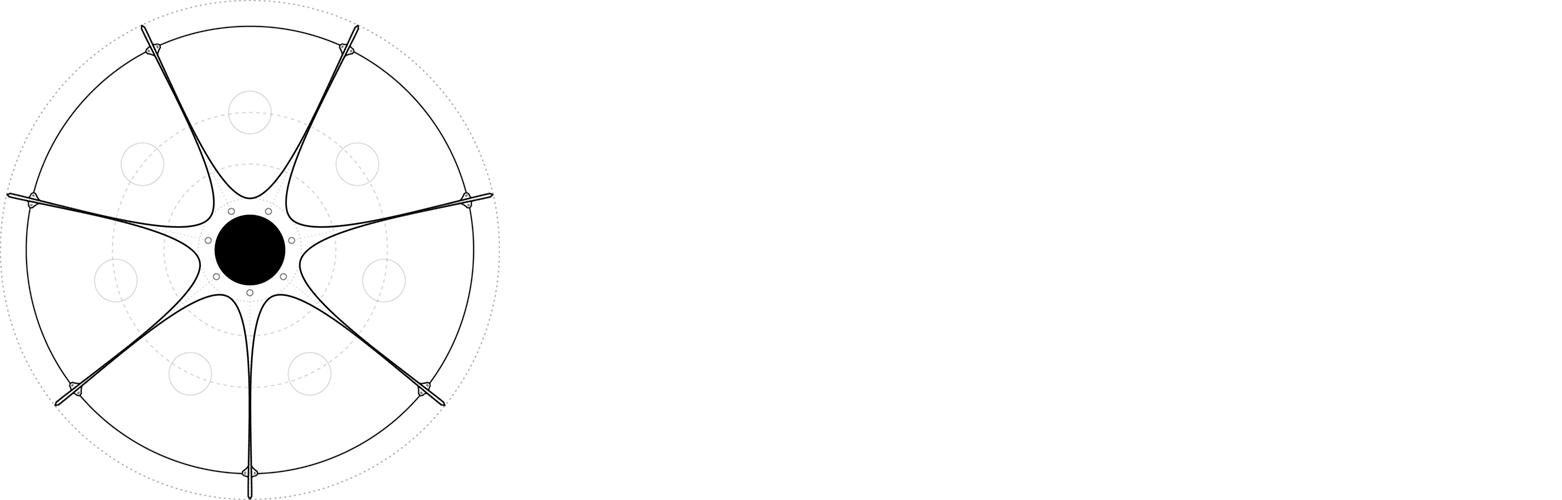
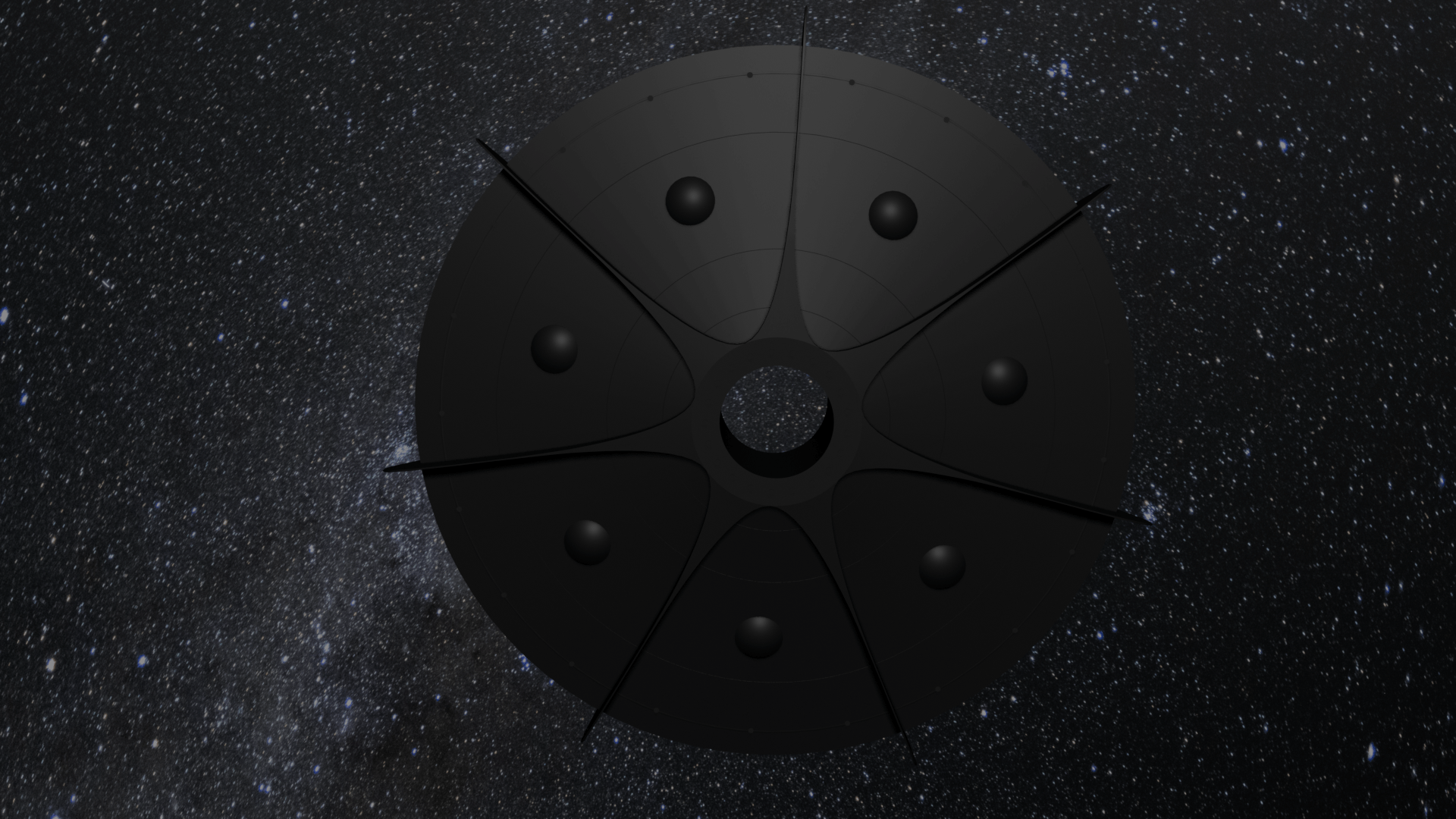
Many of the interstellar ships of Arthur Breur’s Frjósöm Universe (including Q’Enmari) have a distinctive design that provides highly consistent “perceived gravity” during rest, acceleration, coasting, and deceleration — no special “artificial gravity” technology required, just physics.
This “Combined Centrifugal/Thrust Gravity Vector” system (or “CCT GravVec”) operates by incorporating habitat compartments that can each rotate 180 degrees within the overall structure of the ship, even as the ship changes between rotational operations (at rest or while coasting) and acceleration or deceleration.
At “rest” (that is, when not under propulsive thrust) the ship rotates, and perceived gravity is “outward” — that is, the habitats each orient so that their “down” direction points outward as the ship itself slowly rotates to provide a centrifugal effect. As an example, Q’Enmari’s own habitats are 1-cubic-kilometer spheres with their centers positioned 4 kilometers from the ship’s overall center of rotation. At full rotation, she turns about once every 2 minutes if she is providing 1 standard gravity (“1g”) to her passengers.
During acceleration, a CCT GravVec ship’s rotation is gradually reduced as acceleration is increased, and the habitats themselves slowly orient so that “down” for each habitat becomes “behind” as the ship begins to accelerate forward. (Imagine how you are pushed into a seat as a car rapidly accelerates.) Rotation stops when the acceleration provides the full desired perceived gravity. As with cruise ships at sea, acceleration starts gradually so that passengers feel no jolt or change in the strength or direction of their perceived gravity.
When entering a coasting period — or at “turnover” when it is time to start slowing down — a ship again slowly begins to rotate, gradually reducing forward thrust as the centrifugal effect is increased. The habitats slowly orient again so that “down” points “out” from the center.
At turnover (switching from accelerating to decelerating), CCT GravVec ships have no need to physically reorient themselves; such ships are designed with both fore and aft thrusters — or with thrusters that can also change orientation to point forward or backward.
When switching to deceleration, braking thrust is gradually applied as ship rotation is reduced and the gravity vector gradually changes from outward to “forward.” That is, habitats begin to orient so that “down” is now the forward direction. (Imagine the feeling of being pulled into your seat belt when a car is braking quickly.)
And that’s how it is that CCT GravVec ships can provide highly consistent “perceived gravity” for their passengers during an entire voyage and when at a destination, such as when in orbit around a planet. Passengers need never experience the awkwardness, the disorientation, or the embarrassing physiological effects of microgravity.
0 Comments